Wednesday, November 4, 2009

Response Paper II: Cultural Space and Urban Place

“Sex and the City”: “Brovaries” before Ovaries?

In his Anthology of Cultural Theory, “Cultural Studies: Theory and Practice,” Chris Barker discusses the concepts of time and space in terms of their relation to culture. Barker contextualizes time and space within the discourse of contemporary cultural theory when he cites Giddens’s connection between social and special life. As Barker explains, Giddens essentially says, “Human interaction is situated in particular spaces that have a variety of social meanings” (Barker 374). This means that location, especially its relation to other locations, shapes both social meanings and, by extension, social interactions. In marking the progress of the urban lifestyle, with respect to space and time and their effects on human relationships, Barker later discusses Louis Wirth’s denotation of the cultural and lifestyle diversity of urban living; specifically, Barker says that Wirth believed that cultural and lifestyle diversity of urban living “as promoting impersonality and mobility (social and spatial) as people lost a sense of ‘place’ and stable social relationships” (Barker 381). Perhaps a deeper insight by Wirth is that:

“Urban living was based on having large numbers of people living in close proximity without really knowing one another. This required them to conduct instrumental transactions and passing encounters leading to superficial, transitory, competitive relationships. From this grows a sense of alienation and powerlessness. However, Wirth also points to the way city dwellers form associations with each other based on lifestyle, culture and ethnicity. (Barker 381)

What does this all mean for the contemporary working class female in the metropolitan New York city life? It means that impersonality and social/spatial mobility have fostered a tradition of unstable, competitive and transitory human relationships within tumultuous and buzzing urban city life. The danger of this is people are alienated from their friends and family and are left listless and disassociated with familiar relationships. However, Wirth explains that lifestyle and culture can tie these alienated urban dwellers together.

In the “Sex and the City” clip, below Giddens’s and Wirth’s assertions comingle and come to life as Miranda attempts to reconnect with the ostensibly dislocated and alienated Carrie. Carrie has been enmeshed in her boyfriend, Mr. Big and her heterosexual romantic relationship and is spatially distanced from her other girlfriends. In this way, Carrie is affixed between two different modes of space and time: the boyfriend and the girlfriends. Carrie’s character, as shown in this particular clip, is disassociated with her previous relationships for the sake of her new relationship. She is tied to both her boyfriend and girlfriends based on her lifestyle and culture even in a highly transitory urban space-time lifestyle. Thus Carrie’s dilemma—the competing relationships based on a proximity-time relationship.


Works Cited:

Barker, Chris. Cultural Studies: Theory and Practice. Los Angeles: Sage, 2008.

Wednesday, October 14, 2009

Response Paper


"You Are Who You Love, Not Who Loves You"

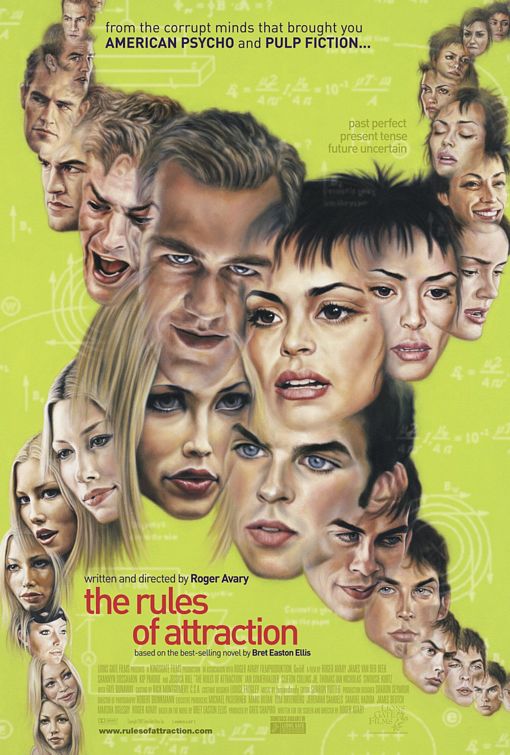
In her book on Romantic Comedies, Romantic Comedy: Boy Meets Girl Meets Genre, Tamar McDonald offers, “By withholding the revelation of the man’s deceit, the radical romantic comedy can be seen as suggesting both that everyone lives a lie, and that the liar, in the end, is the one who suffers the most” (65). Bret Easton Ellis’ novel, “The Rules of Attraction,” operates off this characteristic, as each of its characters fail to realize their mendacity and malice toward one another. In this way, “Rules” is the most disparaging breed of radical romantic texts in contemporary literature to date. The students at Camden live according to their own self-reflexivity and hedonism, as they strive to find their identities and meanings in a loveless world. Moreover, Spike Jonze’s film, “Adaptation” deals with the same types of characters in the same apathetic and vapid postmodern world that threatens any lasting and meaningful romance. Spike Jonze’s film, however, makes explicit what Ellis’ implies in his long running and dense narratives; “Adaptation’s” narrative elucidates the death of romance, real romance that is, in a postmodern world, as well as in the despairing world of Ellis’ Camden—namely Spike Jonze unburies what McDonald’s assertion on mendacity has to say about contemporary love, or the lack thereof, in “Rules.” The film pointedly marks the romantic and ontological dilemmas of Ellis’ Camden— how self-reflexivity leads to a confusion of passions, which in turn, fuels their constantly shifting sense of meaning, which ultimately leads to a dissolution of relationships both with others and with the subjective self.

Not only does Bret Easton Ellis’ “Rules of Attraction” fall within the category of a Radical Romantic Comedy, it does so primarily because of its narrative presentation of several voices; through each self-serving, pragmatic narrative, Ellis uncloaks the downside of such self-reflexivity for a generation who seeks to mollify their very own versions of romance, sexual appetite, and, perhaps, love. In Ellis’ novel, his moralist statement on the lost generation of the 1980’s epoch of abundance, the now-turned-gay character Paul comments, “No one ever likes the right person” (Ellis 261). This concept, the lack of genuine relationships and ties within a college community which is comprised of predominantly self-serving individuals looking to fulfill their own romantic desires, embodies the dilemma of an entire population at Camden. Essentially, Paul is saying that, at Camden, nobody can maintain real, lasting, and meaningful ties with anybody else; everybody is dissociated, detached, and alienated from another. What Paul hints at here speaks to what is perhaps the most distinguishable and critical axis of appeal for the Radical Romantic Comedy, Tamar McDonald establishes self-reflexivity as the cause to the social disease Paul laments in “Rules.” McDonald says that, “The major thematic concerns of the radical romantic comedy all derive from issues of self-reflexivity” (67). Because every character at Camden loves somebody else, no two people can meet each other mutually in romance or understanding; every character is similar because they search for an idealization of a love that doesn’t and cannot exist in their vapid society, while every character differs in deciding who embodies such an idealization for them individually. Yet Paul’s poignant, if not temporary, insight into Camden desire gains an even deeper understanding aside a key scene in the Spike Jonze’s film, “Adaptation.” Caught within a moment of impending danger, anxiety, and inundation, the Kaufman twins share a moment together, which succinctly sums up the entire film’s theme of realistic, difficult romance:

Charlie Kaufman: There was this time in high school. I was watching you out the library window. You were talking to Sarah Marsh.

Donald Kaufman: Oh, God. I was so in love with her.

Charlie Kaufman: I know. And you were flirting with her. And she was being really sweet to you.

Donald Kaufman: I remember that.

Charlie Kaufman: Then, when you walked away, she started making fun of you with Kim Canetti. And it was like they were laughing at *me*. You didn't know at all. You seemed so happy.

Donald Kaufman: I knew. I heard them.

Charlie Kaufman: How come you looked so happy?

Donald Kaufman: I loved Sarah, Charles. It was mine, that love. I owned it. Even Sarah didn't have the right to take it away. I can love whoever I want.

Charlie Kaufman: But she thought you were pathetic.

Donald Kaufman: That was her business, not mine. You are what you love, not what loves you. That's what I decided a long time ago. (Jonze “Adaptation”)

This definitive scene from “Adaptation” eloquently splays out the allure of the Romantic dilemma Paul so concisely outlines. Donald Kaufman’s character beautifully, if not overly tersely, defines the major pitfall of a self-reflexive love in the Radical Romantic genre, which, by definition, examines both women’s and men’s romantic needs on a more equal plane than earlier Romantic Comedies have before. Moreover, Donald’s revelation reveals the appeal of self-reflexive love in modern society; everybody’s version of romance is different and polarized from anybody else’s, while there is something hopeful in our own, unique versions of love whether they are realized or not. When Donald says, of his unnoticed, unrequited love of Sarah, “It was mine, that love. I owned it,” he suggests that self-reflexive love, although illusory and potentially blinding, can offer insight into one’s own identity, into one’s own values, morality, and desires. In discussing theorist Giddens’ argument on self-identity as a project, author Chris Barker concludes that, “Self-identity is not a distinctive trait, or even a collection of, traits, possessed by the individual. It is the self as reflexively understood by the person in terms of her or his biography” (Barker 217).

Barker ties the scene from “Adaptation” in with Paul’s quote from “Rules” in one crisp breath. Barker implies that identity isn’t a possession or collection of traits that, we decide, makes us unique. Rather, he says that identity is our own invention, our own way of viewing ourselves in a confusing world; it is a procession of discoveries and desires through the changes in time. Self-identity, thus, is a self-reflexive construction of our own making; it’s our way of making sense of the changes in our lives and the un-fulfillment of our desires. Concordantly, Ellis’ “The Rules of Attraction” is an amalgamation of self-reflexive voices, each lost and struggling to find its place within a changing definition of romance and love, within the heterogeneous mess of romantic desire at Camden. Each character spirals out of control within their personal existential crises while they define themselves using the idealization of romance in other, uninterested individuals. They are vexed by their self-reflexivity while they are simultaneously defined, and in a sense, empowered by it.

However, in Ellis’ “Rules,” the characters also seem to not entirely know who or what they want. They merely have a desire, an insatiable void, which they try to mollify. A great example of this unknown, fleeting and finicky desire is the scene where Sean Bateman wonders if the girl at the dining hall is the girl who has been sending mysterious and passionate love letters in his mail box. Trying to put a face to his incessant desire, to love, to feel loved by somebody real, Sean comments, “So, I’m looking at that girl, wondering if she’s the one who’s been putting those notes in my box and I get excited—even if it’s not her” (Ellis 44). In a sense, Sean simply wants to know what real love is. He is in love with a faceless admirer, and, thus, he is in love with the concept of real love, even if it isn’t fully or clearly realized. Everybody wants to be loved in Ellis’ book but they do not understand the mutuality real love requires or its consequences. In this light, Ellis’ characters are dispassionate and apathetic; they float through a seemingly endless path of hedonistic enterprise and at the cost of their own expectations and sober, personal introspection and growth.

Perhaps the forlorn romantic, Susan Orlean, captures Sean’s, and by extension, Camden’s, bottomless appetite for passion and substance. She says, “I suppose I do have one unembarrassed passion. I want to know what it feels like to care about something passionately” (Jonze “Adaptation”). While all of Jonze’s and Ellis’ characters search for the capacity to feel, the capacity to love outside themselves, Susan Orlean is no exception. Her quote provides the subtext to Sean Bateman’s quote—like Orlean, Bateman and his peers draw their impetus to exist from wanting to want to love. Chris Barker cites novelist Milan Kundera in discussing choice and determination in relation to an individual’s subjective identity: “‘We can never know what to want, because, living only one life, we can neither compare it with our previous lives nor perfect it in our lives to come’ (Kundera, 1984: 8)” (Barker 235). As Barker points out, Kundera implies that the individual has no point of reflection within the modern confusion they are subject to and consequently suffer from a lack of solidarity in identity coupled with an unclearness of what they desire. This aptly speaks to “Rules.” Sean Bateman, as well as all of Camden, is passionate about finding passion. Camden’s inhabitants are so obsessed and lost within their own self-reflexive plight that they don’t even know what they want. They have selfish desires that ultimately devour any semblance of morality and decisiveness in their stupor, misrecognition, and truculence.


Jacques Derrida is immediately recalled when examining Sean Bateman’s love for Lauren in “Rules.” Barker sums up Derrida’s “Défferance,” in one swift sentence—“The Production of meaning in the process of signification is continually deferred and supplemented” (Barker 85)—and sums up Sean’s, and Camden’s, romantic endeavors. At the pinnacle of his illusory and misplaced love in Lauren, Sean is fixed on her superior qualities as a woman; he explains:

I knew she loved me, and not only because of the notes, which I refused to bring up (why embarrass her?), but because when she looked at me, I could see, for the first time, just sense, that she was the only person I'd ever met who wasn't looking through me. She was really the first person who looked and stopped. It was a hard thing to explain to myself, to deal with, but it didn't matter. It wasn't the most important aspect. Her beauty was. (Ellis 181)

Aside from the fact that Sean starts off admiring his personalization of Lauren to his needs, he rests his confidence in her beauty a couple sentences later. The reasons for Sean loving Lauren, if at all certain or warranted, change even at the height of his admiration and desire for her. Later, as Sean and Lauren’s “relationship” deteriorates, Sean marks the end of his struggle to try to find something substantive and appealing in Lauren. Right before entering Vittorio’s party, Sean thinks, “This is the end of the relationship. I knew it was coming to an end. She was starting to bore me already. And maybe this party is a good excuse to end it, to lay blame somewhere. I don't care. Rock’n’roll. I look at her one last time, in the seconds before the door opens, and desperately try to remember why we even got together in the first place” (Ellis 191). In just ten pages of “Rules,” Sean goes from being madly and inexorably in love with Lauren to sharply despairing of any future with her. But Derrida’s claim only provides some of the answer to Sean’s question—why he has connected, or pretended to connect, with Lauren in the first place. Not only does Sean’s relationship change meaning, albeit drastically and quickly within the narrative, it begs the question: why do Sean’s, and his Camden peers’, passions shift so greatly?

Again, Jonze’s “Adaptation” elucidates the drive to engage in an ultimately listless vacuous desire to feel Ellis’ lost generation so adamantly search for. Susan Orlean, Jonze’s most hapless romantic, mirror’s Sean Bateman, who is arguably Ellis’ most hapless romantic. In discovering why people desire to love, Orlean notes, “There are too many ideas and things and people. Too many directions to go. I was starting to believe the reason it matters to care passionately about something, is that it whittles the world down to a more manageable size” (Jonze “Adaptation”). Just as Bateman and the Camden kids are passionate about finding real love, Orlean does, too. However, Orlean explicitly encapsulates why the characters in her world, as well as those in Ellis’ world, are sucked into predictably tenuous and condemned relationships with each other. Orlean’s quote links the Camden kids’ self-reflexive identities, search for passion, and shifting relational meanings with each other; the “Rules” kids live in their own, independent, self-reflexive worlds, struggling to clarify identities for themselves and unaware of the real consequences real love and passion require—thus, their self-reflexivity hinders their capacity to be distinct, genuine, relatable characters who operate with decisiveness in a changing and overwhelmingly disparate world. They are really seeking simplicity in a postmodern dissociation of identities and meanings.

It has been repeated that taste is a matter of morality, but Ellis’ “Rules” argues for the reversal of this statement. Without a selfless consideration outside themselves, the kids at Camden disable any possibility of realizing a lasting and meaningful relationship. Roxanne, Lauren’s dining hall friend comments early in the novel, “I’m beginning to think romance is a foreign concept” (Ellis 41), and illustrates the consequences of an unrealized identity in relation to other people outside the self. Although, the self-reflexivity and emotionless relations of Ellis’ characters can be read as mechanism in which they adapt to a changing and increasingly confusing, unforgiving and apathetic world of excess, their indecision can be read as their only means of survival. The problem with this reading, though, is that Ellis’ characters struggle to survive without lasting reflection or the hope for improving themselves as sensitive humans. Jonze’s eccentric character, John Laroche speaks with his romantic admirer, Susan Orlean in a seminal moment of “Adaptation.” Their interchange suggests that we shouldn’t sympathize with Ellis’ lost generation in “Rules.” To Susan, John poses, “You know why I like plants? Because they're so mutable. Adaptation is a profound process. Means you figure out how to thrive in the world;” Susan retorts, saying, “Yeah, but it's easier for plants. I mean they have no memory. They just move on to whatever's next. With a person though, adapting is almost shameful. It's like running away” (Jonze “Adaptation”). Ellis’ Camden kids inhabit both standpoints. They adapt to their situations pragmatically, often at the expense of other people’s emotions and wellbeing, and their self-reflexive, existential and ontological crises are a result of their need to survive at Camden, albeit without a firm understanding of themselves.

Every character in “Rules” is figuring out how to survive in their world, but not necessarily how to thrive in it—they are only struggling to survive; they are not surviving to grow as people but as separate and equal entities. Unlike plants, the Camden kids, are humans with memories, albeit selective ones tailored to their hedonistic whims. They run away from each new crisis in their lives yet they are about as shameless as a plant is in its adaptation. In this fashion, Ellis’ characters are the dregs of humanity. They resemble the shells of human potential while exuding humanity’s worst attributes: avarice and gluttony. As Chris Barker notes, “There is no essence of identity to be discovered; rather, cultural identity is continually being produced within the vectors of similarity and difference” (Barker 229), Ellis’ lost generation are all similar in their vacuous self-reflexivity and moral-relativity, while they differ from another in what and whom each loves. Their desire is rooted in the same empty desperation, as their objects of affection shift along a continually reconstituting chain of meanings and emotions.


Works Cited

Adaptation. Dir. Spike Jonze. Perf. Meryl Streep, Chris Cooper, Nicolas Cage. Columbia
Pictures, 2003. Film.
Barker, Chris. Cultural Studies: Theory and Practice. 3rd ed. Sage Publications Ltd, 2008.
Print.
Ellis, Bret Easton. The Rules of Attraction. New York: Random House, Inc. 1987. Print.

McDonald, Tamar Jeffers. Romantic Comedy: Boy Meets Girl Meets Genre. London and New
York: Wallflower Press, 2007. Print.

Thursday, September 24, 2009

Ethnography

The Attractive Truth: The Structure of Social Appeals


Location: Gelson’s Market: Calabasas, CA (inside at a fireplace table adjacent to the Service Deli area)

Time: 6:30 pm Friday night

Observations:

The electronic sliding door opens to the left. Many shoppers talk and their voices blend into a loud clamor. They wait around the Service Deli. A woman, appearing to be well into her 80’s, enters. Her face is consumed by an exaggerated wince. Her eyes smile and her back hunches forward. She sports a teal windbreaker sweat suit with bright red crocks. Her face looks like a desperate bulldog’s. Her skin has a blotchy sheen of jaundice and her nose is bulbously. Her brown, beady eyes hide behind a pair of spectacles, which rest nicely on her prominent nose. Her eyebrows are quite obviously penciled in without precision; they rest directly in the middle of her forehead. This octogenarian’s hair is wiry like a spool of used copper as it is also appears to be copper in color. She resembles a slightly effeminate and contemporary version of Ben Franklin; her hairline recedes and she is balding very ostensibly from the top of her scalp just to the edge of her crown. She reeks of what seems to be a combination of halitosis and body odor. The old woman clutches her purse, laced over her right shoulder, with her left hand, as if to protect it with a paranoid urgency. Her earlobes and cheekbones sag as she plods to the service deli nearby. Her jowls and brows plunge when she takes a number from the dispenser to wait in line. Then, upon glancing at her number and squinting vehemently at the “we are now serving number 58” display above the counter thereafter, she shakes her head twice, places her hands on her waist directly in front of the display. She is static for about 15 seconds, her eyes fixed on the number on the display, waiting for it to change, counting time by taping her left foot on the floor. Suddenly a younger woman, in her mid thirties, leggy, tall, and dark, briskly slides in front of the old woman, shoots her a quick conciliatory glance, grabs a number from the dispenser, and smiles at the clerk behind the counter. The old lady remains in a state of frustration coupled with a bleak malaise, which makes her appear sad and angry at the same time. The younger woman has about a solid C cup chest, her hair is black, her skin is olive color, and her predominate facial feature is her statuesque chin. Around her hazel eyes are regions of skin that appears tighter than the rest of her face. She is in good shape. She sports a vibrant orange sundress, which reveals her dark shoulders and upper cleavage. Her tiny ears are attached to pearl earrings and her lips are red. Her feet rest in Greek styled sandals and her toenails and fingernails match her sundress. Her wrists are dressed in not one, but two Tiffany’s silver bracelets. Her demeanor is upbeat, urgent, yet focused. After saying “Hello, Mario” to the clerk behind the deli counter, she self-consciously looks around a congregation of people waiting for the deli—thirteen people wait anxiously. About 30 solid minutes fly by—within which the crowd slowly shrinks to four people, including the older and younger women. During this interval, both women shared a panicked interest in one item: the lobster salad at 13.99 a pound. The older woman doesn’t smile once while intently examining the salad she wants to purchase. Her head dips and tilts when the clerks bring out a new batch of the salad. While the older woman studies her buy, the younger woman talks on her cell phone, an Apple I-phone 3Gs. Her conversation is casual at first. Then she raises her high-pitched voice. She nervously itches the back of her neck with her index finger before breaking into a fit of playful laughter. She says the word, “Fuck” nine times and the word, “cunt” three times. Before hanging up, she caresses her left shoulder, then her chest, and then her neck. All of the sudden, the number 70 blinks on the display above the deli counter and both women quickly check their numbers. Leaning forward, her penciled-in brows raised in expectation and panic, the old woman remains in her original standing position while waving her number in the air like a winning lottery ticket. She grunts in anticipation while the young woman in front of her swoops to the counter space in front of the old woman, rests her elbows on the counter and immediately engages in flirtatious conversation with the clerk. The young woman smiles at the clerk and bats her eyelashes about four times. The clerk, a young Mexican-American man, perhaps in his mid twenties, smiles at first, quickly glances at the old woman and then returns his attention to the younger woman in front of him. The clerk quick and overly-obedient to the younger woman, shells the salad into a large container, slaps a price tag on it and slides it on the counter space dividing the young woman from him. His delivery of the salad occurs blazingly fast, in which it seems is less than 15 seconds pat. The young woman moves her hands to rest on her tiny buttocks; the clerk takes notice of this swiftly and returns his glance to her. When she thanks him, the young woman rests her hand on the clerk’s hand ever so quickly and gently. She retracts her arm before tilting her head. She says, “thank you so much, honey” before winking and storming off with her salad. During this entire exchange—between the young clerk and the young woman—the octogenarian is throwing up her arms in the air, yelling loudly at the entire deli staff. The five staff members intermittently glance at the old woman with blank faces and the young Mexican clerk avoids any eye contact with her whatsoever. The old woman repeatedly points to him angrily, albeit at a good distance from the counter. She is chastising the staff for his behavior. She repeats the phrase, “I was before her, you know. That’s not fair. This is outrageous”. When she says this, she is yelling. Any customer within a close proximity of the old woman quiets. Her voice starts off bold and confident and simmers into a breathless strain. She is shaking her head violently now. She pauses for a moment then returns her attention to the salad. She exhales audibly and forcibly before taking a long hard, despairing stare at her feet. She quiets down, takes off her glasses, pinches her nose, and then deliberately and furtively lets her number drop to the floor. She turns away from the deli, her hand over her whispering mouth. She is off in her own world, while the other grocery patrons remain quiet and observant of her every action. Then, she pipes her eyes up to the exit doors nearby and stares blankly and endlessly to the parking lot in the distance. She ambles from the deli area to the exit. Her eyes are watery and squinting. She sniffles once and wipes her nose with a vibrant-white handkerchief. Her purse is clutched, and her mouth is straight, almost indifferent. She stops before finally exiting the store before momentarily glancing at the service deli clerk she had accused. Then, in a flurry, her pace quickens and she heads out. The store gradually resumes its usual clamor and onlookers return to their shopping and waiting.

Analysis:

Reflecting upon my objective observations, a couple philosophical quotes come to mind. The first theory I thought of relates to Giddens’s theory of social identity with respect to the duality of structure. Giddens’s major point is that structures enable and constrain individuals who are, according to him, actors predetermined by greater social forces. Barker encapsulates and extends Gidden’s theory, though, when he specifies that Gidden’s theory implies these greater social structures enable an individual’s actions, too. Barker paraphrases this sentiment, saying, “Identities are understood to be a question both of agency (the individual constructs a project) and of social determination (our projects are socially constructed and social identities ascribed to us” (Barker, 233). Thus, the seemingly unattractive octogenarian and the younger and ostensibly more attractive, more suggestively dressed woman played out their roles in the context of waiting for their salad. Specifically, the role of the old woman, who was quite obviously and unfairly judged on her looks suffered for her role. To the young deli clerk, the old woman was unattractive and the younger woman was gorgeous and appealed to him. He was socially constrained by his job to call on the next person in line, regardless of what they looked like, or, really, who they were. He decided to help the younger woman when it was the older woman’s turn to order because he was enabled by her proximity to the counter in contrast to the old woman’s distance from it, and acted on his attraction, rather than occupational duty. So, within Gidden’s theory on the duality of social structures, the young clerk was both constrained and freed within this situation; it all had to do with whether or not he could get away with it, whether it was practical to the given situation; the clerk, then, assumed his agency within the power of his job over the old woman’s. Yet, Gidden’s incorporation of social determination cannot be ignored in this situation either. He was the decision maker in this situation, or at least he made him self one; he, really, reproduced a social interaction that occurs everyday—a young man will be more attracted to a hot body than an old face. He is, therefore, enabled and disabled, within this given situation, within prescribed, socially constructed identities. Any young man, who could have gotten away with what the young clerk had done would have at least been inclined to do the same, if not actually act out the same way given the circumstances.

But what is really being socially dealt with here? What characteristic is responded to in each woman? The answer to these questions relates to what Butler says about “sex” as an ideal construct. She argues that, “‘sex’ is an ideal construct which is forcibly materialized through time. It is not a simple fact or static condition of a body, but a process whereby regulatory norms materialize ‘sex’ and achieve this materialization through a forcible reiteration of those norms” (Butler, 238). In the scenario I witnessed, the “sex”, or gendered identities of the young and old women are materialized and reiterated. In this case, then, by extension of this theoretical standpoint, it is reasonable to say that the old woman’s appearance was punished, while the better looking, young woman’s was rewarded. The situation materialized gender roles, but also with a strict respect to sexual appeal. For the deli clerk, the old woman was not desirable, and the young woman was “hot;” in breaking the rules and letting the more attractive woman go before the older one, the clerk, then, materialized the importance of a woman’s looks in getting what she wants from a man. In this situation, the “regulatory norm” is male attraction to appearance; while his response to each woman is natural, it foments an unjust decision on his part.

The quote that ties the first Barker quote best with Butler’s is also from Giddens. The theorist, Barker, sums up what Giddens has to say about social identities within given situations. Barker summarizes Giddens, saying, “ The proliferation and diversification of contexts and sites of interaction prevent easy identification of particular subjects with a given, fixed identity. Thus the same person is able to shift across subject positions according to circumstances” (Barker, 231). This really applies to the meat clerk and his response to the women. He acts based on social constrictions and freedoms, but only within his situation. He knows what he does is wrong, yet he can’t resist his desire. The young Mexican deli clerk makes less than 12 dollars an hour, yet he has the power to reduce an old woman to tears and pet an attractive, younger woman’s ego; outside of work he would never have such power, or at least its unlikely. Yet within his occupational influence he makes a judgment call based on the attractive traits socially prescribed to him of the “sex” of a certain woman over another’s. Are his actions despicable? Yes. But shouldn’t the social structure assume some blame too?

Works Cited

Barker, Chris. Cultural Studies: Theory and Practice. Los Angeles: Sage Publications, 2008.

Tuesday, August 18, 2009

Final Analysis Essay


Patrick Bateman's Morning Routine Scene 

Simply Not There :

 Jacques Lacan’s and Karl Marx’s philosophies on Society and Language elucidating Patrick Bateman’s sense of Alienation in Mary Harron’s American Psycho

         The 2000 movie American Psycho is one of the most misunderstood and debated movies in cinema history because of its social, linguistic, gender, existential, and metaphysical implications. A myriad of critics have examined the film under a postmodern lens, but there are more subtle forces at work within its protagonist’s existential journey. In the scene where Patrick Bateman, the film’s protagonist (played by actor Christian Bale) prepares his morning routine we get deeper insight into the source of his alienation, as he is alienated from sanity, mankind, and from his own true sense of identity and individuality. Just as Lacan concluded that we are defined and alienated by language, we find that Bateman is no exception. In his morning routine monologue, he introduces his home, age and name, and simultaneously reveals his social class in the Marxist sense. His signifiers’ signified ideas as a whole serve to define his social location; his extensive lists of beautification products reveal that he is obsessive with materials, as he is defined by the relationship his words have in naming them; his introspective conclusion—that he is merely an idea that is alienated from a name—relates to Lacan’s theory of linguistic alienation within the human psyche; when he peels off his mask in front of the mirror, Bateman demonstrates what happens to the human conception of self when one enters Lacan’s Symbolic Order during The Mirror Stage; his final introspection, where he reveals that he “simply is not there,” parallels Lacan’s theory that, with language, the signified dissolves into the signifier in the end. Altogether, Lacan and Marx help us understand what gives Patrick Bateman’s unconscious desires—to fuck and kill excessively—impetus.

            But before using Lacanian theory to elucidate Patrick Bateman’s alienation, it is critical to understand Lacan’s philosophy first. As a French philosopher, Jacques Lacan has had a seminal influence on literary theory primarily because he predates Marxist thought in terms of how we, as humans, are socially identified by the language which predates us. When we are born, Lacan would say, we are born into a world that teaches us language, defines us with language, and associates physical objects with words for us. Language, he would argue, is socially prescribed to the human child who enters a new world through maturation—an adult world of social classes and hierarchies; Lacan says specifically, “In other words, the man who is born into existence deals first with language; this is a given. He is even caught in it before his birth” (The Symbolic Order). In his essays, The Mirror Stage as Formative of the Function of the I as Revealed in Psychoanalytic Experience and The Symbolic Order, Lacan plunges the idea of “self” into culture. He says that we are all shaped by the Symbolic Order into which we are born—this order is a realm of symbolization with which children must translate themselves with their words, or spoken language. Lacan denotes this order when he says, “Man speaks, then, but it is because the symbol has made him man” (The Symbolic Order). The Symbolic, then, is how we are defined within, and by, the greater social conventions. When children learn to make symbols, they learn to detach from their childhood realm of objects and attain a sense of independence through a loss. This loss can never be a gain; this void can never be filled, as human desire is rooted in it, as we struggle to fulfill our sense of lost unity within. This craving, this desire for unattainable unity, is what Lacan calls the Imaginary Order; it is the part of the human mind that narcissistically establishes and defines the Ego’s activity. Lacan emphasizes that the ego thinks it has control of the id, but in actuality doesn't. He argues that the Ego, then, tries to reach this unattainable unity within, but in the end, is always unable to. This unattainable unity is part of what Lacan defines as the Real order, which embodies the human instincts, drives and unconsciousness that shapes our personalities. Altogether, Lacan’s essay denotes the self as a delusional and social construct afflicted by imaginary identifications with a false sense of wholeness and unity.

            In the morning routine scene from Mary Harron’s film, American Psycho, we meet Patrick Bateman, a wealthy Wall-Street businessman by day and a bloodthirsty serial killer by night. He introduces himself, first, with where he lives, his name, and then his age: “I live in the American Gardens building on West Eighty-First Street, on the eleventh floor. My name is Patrick Bateman. I am twenty-seven years old” (Harron). Right off the bat, we place Bateman in the upper class, Marx’s Bourgeoisie, of society; he is in his prime in age and in material wealth. Following a brief introduction, Bateman expresses what he values—“I believe in taking care of myself, in a balanced diet, in a rigorous exercise routine” (Harron), and reveals that, “In the morning, if my face is a little puffy, I'll put on an ice pack while doing my stomach crunches. I can do a thousand now” (Harron). Immediately, the audience is presented with a character who is wealthy, youthful, and deeply concerned with his physical appearance. Although he is unaware of how he is defining himself, as he simply states facts about himself and his lifestyle in the beginning of the clip, Patrick Bateman is actually revealing which social strata he belongs to and associates with based on his language—the Marxist Bourgeoisie. When Karl Marx says “They do not know it, but they are doing it” (Capital 669), he means that people operate within an ideology, within a social class, entirely, whether they are aware of it or not—that social classes, and their respective ideologies are inescapable in the long run. Ideology and language can be interchanged here, as a certain language belongs to a certain ideology. Bateman, here, exemplifies how one’s seemingly harmless and unassuming introduction can carry socio-economic implications. In fact, the entire scene can be said to display the language of an ideology—the upper class ideology. Within his first couple of introductory sentences, we immediately discover that his voice has the sound of a refined, upper class individual; his voice is collected and overly-confident, his words dispassionate and itemized.

            After he introduces himself within an upper-class discourse—as a health and appearance conscious individual—Patrick Bateman reveals his obsession with the countless hygienic products he uses, as he utilizes the material world to establish his “self”. In listing these objects, he uncloaks his attachment to them, as he uses them to define his refined image and his social identity:

In the shower, I use a water-activated gel cleanser, then a honey-almond body scrub, and on the face, an exfoliating gel scrub. Then I apply an herb mint facial mask which I leave on for ten minutes while I prepare the rest of my routine. I always use an after-shave lotion with little or no alcohol because alcohol dries your face out and makes you look older. Then moisturizer, then an anti-aging eye balm, followed by a final, moisturizing ‘protective’ lotion. (Harron)

Patrick Bateman’s character illustrates Lacan’s theory on language. Lacan says that language gives us an identity, that “it is the world of words that creates the world of things” (The Symbolic Order); thus, Patrick creates his world of things within the world of words. The products he uses for self-beautification are merely products of socially prescribed signified ideas behind a learned chain of signifiers within his socialized language. For Lacan, there is no unified self in this world of words; Bateman doesn't have a unified self either. This ties into what Karl Marx says about commodities, things with a socio-economic value: “There it is a definite social relation between men, that assumes, in their eyes, the fantastic form of a relation between things” (Capital 667). Bateman, thus, defines himself with objects and simultaneously defines himself with words; his entire monologue is an illustration of his relationship to his things, to his “ice mask,” to his “water activated gel cleanser,” to his “honey-almond body scrub.” Furthermore, Bateman’s routine is painted as both extensive, but also ridiculous. The repetitious and multifarious application of skin conditioners and appearance-enhancing products strikes an ironic chord for the audience—this irony is grounded in the fact that Bateman’s excess—in his obsession over maintaining a pristine and exceptionally refined appearance through the usage of a laundry list of material objects—in the limitless lifestyle his socio-economic status provides for him.

            But the scene takes Bateman’s character one step further than just socio-economic status, it reveals what a life of excess—a life based solely on materialism and commodity fetishism—does to the human spirit; it adds to his feeling of linguistic and Psychological alienation from the world’s objective meaning. In the last portion of Patrick Bateman’s morning routine scene, his monologue takes an introspective and noticeably bleak turn. He says, “There is an idea of a Patrick Bateman, some kind of abstraction, but there is no real me, only an entity, something illusory” (Harron). Essentially, Bateman’s concluding introspection in the clip serves as his attempt to come to terms with the separation of the signifiers, and their respective signified ideas, in the Lacanian sense. The insatiable desire for Bateman to become as clean, healthy, polished, and refined as possible, can, then, be said to result from his separation from the meaning in words themselves—he is coming to terms with his lack of being and substance. Thus, Bateman’s extensive morning routine is, in itself, his attempt to replace the void he feels, the fissure between his subjective personality and the objective, outside, social world; he is trying to fill this void with the materials in attempting to identify himself with what he owns, with hygienic products. As Lacan puts it, we, and Patrick Bateman here, “cannot ever find an object to embody what we ultimately” (the Symbolic Order), and ideally want—Bateman slides along a chain of signifiers, whereas each signifier represents a part of a whole, not a whole in itself—he is forever incomplete this way. Lacan says, “For the signifier is a unit in its very uniqueness, being by nature symbol only of an absence” (The Symbolic Order). Therefore, Patrick Bateman realizes that what he defines himself by—his name “Patrick Bateman” quite literally here, with words absolves any true understanding of himself. Just as the countless skin-care and beautification products and itemized style in which Bateman’s introduces them with lose their signified meaning in their ridiculously endless context, Bateman, himself, like language, loses any realization of himself, any idea of himself. He essentially conveys his alienation from language, his alienation from assigning meaning to the countless signifiers he uses to introduce himself with, and his alienation from any true sense of individuality (he is just like his upper class friends).

            Its crucial to note that Bateman looks in the mirror and peals off the mask—an amalgamation of the numerous hygienic, material products he has applied to his face—when he concludes his monologue. When he sees himself in the mirror, he attains a false sense of identification, of wholeness and autonomy, just as the child does in Lacan’s The Mirror Stage: “we have only to understand the mirror stage as an identification…the transformation that takes place in the subject when he assumes the image” (The Mirror Stage 442 ). When he peels his mask off in the mirror, Bateman learns his place in the Lacanian sense of the Symbolic Order and represses an original desire for wholeness and autonomy. Bateman’s repression of his id, of his desire to be whole, his desire to have complete in control of his actions, ties in nicely with how Lacan bridges a child’s repression of his original desire for his mother with language. Lacan says that as a child represses his original desire for autonomy and wholeness is synonymous with how the signifier makes the signified absent, “For the signifier is a unit in its very uniqueness, being by nature symbol only of an absence” (The Symbolic Order). The theorist says that the acceptance of repression and entry into the Symbolic is itself comparable to language in that once one learns to name something, one accepts separation from it: Similarly, in American Psycho, when Patrick Bateman names the various objects associated with his morning routine, he sacrifices each object’s meaning; this is because, according to Lacan, the mere presence of an object’s signifier is the absence of the signified behind the signifier—that is, Bateman’s words, his extensive naming of the expensive and seemingly superfluous hygienic products he applies to his body, only have meaning for him in that he is alienated from their signified meaning. To extend this concept, Bateman is only the product of the objects he owns, or, in this case, of the self-beautification materials he applies to his body on a daily basis. In their application and verbal utterance, Bateman’s spoken commodities confirm the absence of any individuality and substance in character, he has—as his numerous beautification materials are present in his everyday life, albeit in excess, his sense of self is absent in their presence. At its heart Bateman’s story in American Psycho is one which deals primarily with surfaces; when he peels off the facial mask in front of the mirror, he is peeling off a layer of his identity—he is reinventing his sense of self, whether it is merely an abstraction. His mask, which he peels off then, not only symbolizes Bateman’s reinvention, but also his detachment from reality, from words and their meaning, from surface and substance—it serves to show the beginning of his character’s arch from psychopathic to psychotic.

            When Patrick says, “though I can hide my cold gaze and you can shake my hand and feel flesh gripping yours, and maybe you can even sense our lifestyles are probably comparable: I simply am not there” (Harron), Bateman is really saying that he is alienated from everybody, even those within his higher socio-economic class. As Lacan explains, we are split form ourselves and that “we can never possibly attain wholeness in a world of objects” (The Symbolic Order); the ego deludes us with ideals. Patrick Bateman is no different in this scene. Bateman’s lack of being is based on his initial lack of being, from the original instance of his alienation from an imaginary sense of fullness; his id overpowers his ego. Moreover, Bateman’s identity is prescribed by society and he is alienated in the process. As linguistic structures have preexisted Bateman’s character, we can infer that he is merely playing the role of the wealthy young man in the Bourgeoisie camp, in the Marxist sense. He is part of the genetic upper class, and is, thus, fortunate to live a lifestyle of luxury and excess, even if its to the point where even material objects and property lose their meaning for him. His usage of the word, “flesh,” here, denotes the physical human aspect that he attributes to human relations and communication, although he is ultimately alienated to everybody, even himself, by language, and by the material world.

            Bateman is, moreover, split from himself because he can never attain wholeness is his world of objects and the material. Lacan defines the Real as the cause of our desires, which we can only access through signifiers. In American Psycho, the chain of signifiers Bateman operates within represents his desires that never arrive at the Real; the Signifiers he uses only distance him from his desires as he distances himself from objects in the very act of listing them off. Thus, according to Lacan, human desire—here, Patrick Bateman’s desire—is carried by signifiers which stand in for a lack that can never be filled in; Bateman’s unconscious resides in the signifiers of his language, which he uses to identify his socio-economic self. It is crucial to notice that Bateman ends with a tone that resembles a yearning for communication and clarity between men and objects; he illustrates his complete alienation from man, through language, here. His introspection starts with identifying himself as an “idea” and as an “abstraction,” but concludes with his realization that he is, in himself, the absence or void: “I simply am not there”—moreover, Bateman’s conception of himself starts as a Signified and evaporates into a sole Signifier. In a couple sentences, just as Bateman’s words have lost their signified meaning, so has Patrick Bateman lost his own meaning as an individual within a social class. This relates to what Lacan says of language and absence as presence, that, “Through the word—already a presence made of absence—absence itself gives itself a name” (The Symbolic Order); Patrick Bateman, in his character’s absence of substance, understanding, completeness, and unity, symbolizes Lacan’s “presence made of absence” because he is present in defining his own absence; he is the embodiment of “absence” and he gives himself the name, “Patrick Bateman,” although his identity becomes completely associated with his Signified name, completely devoid of the idea he mentioned before.

            Patrick Bateman’s psychological crisis, then, is that he has no real concept of self, except that there is a lack of self, that there is something missing. There is nothing innate within him that he can fall back on—he is basically a murderous vacuum, looking for meaning in the surface of things and people, in the signifiers of his words, in his material objects and their lack of signified ideas. Moreover, every single word in Bateman’s monologue describing his morning routine alienates Bateman himself, as in naming objects in the first place has alienated him from their meaning and importance to his life. He is constantly reinventing himself in every ridiculous situation he finds himself in, after every word in list, after every sentence in his monologue—just as his desires are carried by signifiers which supplant a bottomless hole within him—and he only operates in a world of signifiers, where meaning is just as illusory as his generosity and genuineness.


Works Cited

American Psycho. Dir. Mary Harron. Perf. Patrick Bateman. Polygram, 2000.

Lacan, Jacques. The Symbolic Order (from "The Function and Field of Speech and Language in Psychoanalysis). Julie Rivkin and Michael Ryan. Literary Theory: An Anthology.Massachusetts: Blackwell, 1998.

Lacan, Jacques. The Mirror Stage as Formative of the Function of the I as Revealed in Psychoanalytic Experience. Julie Rivkin and Michael Ryan. Literary Theory: An Anthology. Massachusetts: Blackwell, 2004. 441-446.

Marx, Karl. Capital. Julie Rivkin and Michael Ryan. Literary Theory: An Anthology. Massachusetts: Blackwell, 2004. 665-672.

http://www.youtube.com/watch?v=a-yoMEZXnbQ

Thursday, August 13, 2009

Analysis 4: Post-Colonialism


"The Noble and the Savage": Joseph Conrad's An Outpost of Progress and Edward Said's Orientalism

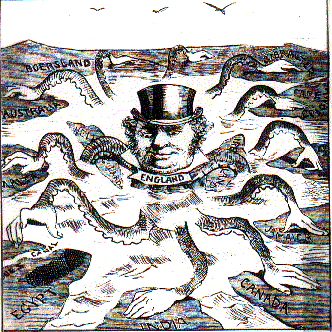
         In Edward Said's essay, Orientalism, he lays the groundwork for a methodical analysis of how England, and other dominant and Imperialist nations, have maintained their international socio-economic grip on the subservient peoples whom they exploit in their expansion. As his theory is grounded in Marxism--mainly that the more powerful class has the control to create and spawn discourses about an inferior "Other" figure. Yet Said's glimpse can be elucidated and enhanced aside Joseph Conrad's short story, An Outpost of Progress; Conrad's short story is a critique of the English Imperialism of the late 19th Century and can be understood in the context of Said's essay. In Conrad's story, we meet two white officers, Kayerts and Carlier, who are Britain's two chosen men assigned to maintain a station, an outpost of progress, if you will, in Africa, among the indigenous peoples--the "others" in the story. 
              
Living on their station's grounds, albeit in worser conditions than the two  British officers, is Makola, the resident domesticated African man. Conrad describes Makola as an African who is  "taciturn and impenetrable" and one who "despised the two white men” (Conrad 1073). Paired with Said's essay, specifically the line, "The Oriental is irrational, depraved (fallen), childlike, ‘different;’ thus the European is rational virtuous, mature, ‘normal’” (Said), Conrad's text comments on how the inferior Africans--the colonized--are ideologically meaningful to the superior conquerers, Britain. Here, Conrad describes Makola the African as "taciturn" to reveal the alienation he encounters from his white, superior, invaders. He is described as "impenetrable" to show that he is socially distant from Cayerts and Carlier, the two white men who are different from him. Yet, Conrad is doing something more than merely explicating Colonialism in Africa here; he uses only Makola to represent the "different" and "normal" officers to uncloak the mentality the British had with their conquered peoples; the author is satirizing British Colonialism. Makola, then, is the "other," defined by the two Europeans but he is, too, the human who is unjustly exploited according to Conrad's depiction of him.
       
If Katerts and Carlier represent the Europeans dominating the inferior Africans, they do so with a certain ideology in mind--one in the sole interest of their conquering nation, Britain. Conrad describes the two officers in the context of this hierarchy when he says, “They had been in this vast and dark country only a very short time, and as yet always in the midst of other white men, under the eye and guidance of their superiors” (Conrad 1074). In addition, Conrad puts his own spin on the hierarchy he has focused on--that which has dictated the actions of its subordinate European officers; the author describes the two Europeans as part of a crowd, who "believes blindly in the irresistible force of its institutions and of its morals, in the power of its police and of its opinion” (Conrad 1074). It is clear that Conrad is criticizing the British or European superstructure which drives its officers in a foreign land, as it forces its subordinates to its ends. Moreover, the two Europeans Conrad uses to critique such ideology also serve to show the inescapable nature and irrevocable influence of the ruling class, or the Conquerers, the British in this story. Said explains that  Orientalism’s rationale is primarily grounded in Western thought and rhetoric in defining Orientals as Others in discorse, that “these representations rely upon institutions, traditions, conventions, agreed-upon codes of understanding for their effects, not upon a distant and amorphous Orient” (Said). Thus Conrad's story isn't only highlighting the differences between the Conquerers and the Conquered, it also focuses on Western dominance over Eastern ideology. After all the conquered will follow the conquerer's ideology as it is impressed on them by force in the end. 
        
Later in the story, the two European officers come across another African tribe and its respective leader; he is describes as follows: “Their leader, a powerful and determined-looking negro with bloodshot eyes, stood in front of the verandah and made a long speech […] and yet resembling the speech of civilized men. It sounded like one of those impossible languages which sometimes we hear in our dreams” (Conrad 1077). There is something subtextual at hand here; not only is the leader powerful and resembling a civilized decorum, Conrad is using him to make a statement on how Otherness works. Said says that, “the Orient is transformed from a very far distant and often threatening Otherness into figures that are relatively familiar” (Said), and we can come to a new conclusion thereafter. Conrad is taking an African tribe, the Others in the story, and likens them to their conquerers, the two European officers. In one poignant sentence, Conrad has illustrated how the savage and incommunicable become civilized and powerful, even similar to their conquerers on an unconscious level in dreams. Subtly and vehemently, Conrad takes the Other and reveals his link to the Conquerers' humanity.
         
 Towards the end of his short story, Conrad has one of his British officers say,“We talk with indignation or enthusiasm; we talk about oppression, cruelty, crime, devotion, self-sacrifice, virtue, and we know nothing real beyond the words. Nobody knows what suffering or sacrifice mean—except, perhaps the victims of the mysterious purpose of these illusions” (Conrad 1080). At heart, Conrad is making a statement on the discourse of a Conquering people, as he uses a white officer, or member of the conquering people, to ironically make his point for him.  Said denotes Orientalism as, “a discourse [that] exists in an uneven exchange with various kinds of power, shaped to a degree by the exchange with power political (as with a colonial or imperial establishment), power intellectual (as with reigning sciences like comparative linguistics or anatomy, or any of the modern policy sciences), power cultural (as with orthodoxies and canons of taste, texts, values), power moral(as with ideas about what ‘we’ do and what ‘they’ cannot do or understand as ‘we’ do)” (Said). Essentially, Said says that the imperial nation conquers a people with their discourse--one which is political, intellectual, cultural, and moral. Said's argument is relevant to Conrad's here--Conrad's European duo acts as the instruments of Britain's Imperial discourse; he uses the British officers to shed unabashed and sober light on what this discourse really is. Conrad, thus, reveals what Said implies--that the discourse of the conquering class, what Said defines as Orientalism (defining an inferior, conquered people as the other), is an illusory tool that has one purpose: to benefit the Imperial nation and exploit the Conquered one.

Works Cited   

Julie Rivkin and Michael Ryan. Literary Theory: An Anthology. Massachusetts: Blackwell, 1998

Conrad, Joseph. “An Outpost of Progress." Broadview Anthology of British Literature. Vol. B. Eds. Joseph Black, Leonard Conolly, Kate Flint, and Isobel Grundy. Peterborough, Ontario: Broadview Press, 2007. 1073-1084.


Wednesday, August 12, 2009

what i did for my presentation on Jacques Lacan


For our presentation on Jacques Lacan I sent out emails to the three other members of my group and met with them after class a couple times to delegate which sections of the Psychoanalytic pieces of theory each member was to present on. In addition to sending out numerous emails to bounce ideas off of team members--both suggesting and listening to others' suggestions--I also printed out each of my group members' handouts which the class received on the day we presented. For my portion--on Jacques Lacan's essay, The Mirror Stage, I put many hours into understanding its key concepts so that I could present them to the class in an informative and clear way; I talked for hours on the phone with an English Grad. Student, Cesar Soto, to get some more insight on Lacan, and on the essay's principles. My handout (below) is an amalgamation of the Rivkin text's Introduction on Psychoanalysis coupled with the Norton Anthology of Criticism's introduction on Lacan. 

Lacan’s The Mirror Stage (Essentially describes the fundamental role of FORM for humans) 

·       Lacan as a Neo Freudian:

o   Developed a Structuralist theory of Psychoanalysis based on linguistic theory of Saussure; “the French Freud”

o   The Ego is not unified, as Object Relationists suggest; it is blind to the drives of the Id (the unconscious); it remains blind to its own placement and construction in and by LANGUAGE

o   Before pre-existing Language assigns us an “I,” we have no sense of self; language gives us identity

o   There is no unified self like the Object Relationists suggested before him

·       The Mirror Stage as a process of self-identifaction:

o   The child sees themselves in the mirror and attains a false sense of wholeness and autonomy

o   This Mirror Stage, though, must be abandoned as the child enters the Social World through The Symbolic Order

o   The child enters the Social World when the father says “no” with the incest taboo that declares the Mother as an inappropriate and different object for and from him

o   The Child learns his place is the Symbolic Order; with the initiation of the Symbolic, the child represses his original desire for the Mother

§  Lacan compares this to the fashion the signifier makes the signified absent; The acceptance of repression and entry into the Symbolic is itself comparable to langue in that  once one learns to name something, one accepts separation from it

§  By naming something a human sacrifices the object because the mere presence of the sign/word/signifier is the absence of the signified/idea behind it

o   The passage from Imaginary to Symbolic orders = there occurs an installation of a combined linguistic/psychological separation of the child both from its initial object—the Mother

o   We learn to be social, to have social identities, by learning to say no, to sacrifice or give up both the initial contact one has with the natural world and with one’s first human objects

o   Our whole life consists of attempts to come to terms with Signifier/Signified separation, a lack of being

o   Our insatiable desire is a product of us trying to substitute an object for the initially absent mother object

o   We cannot ever find an object to embody what we ultimately/ideally—we slide along a chain of signifiers, whereas each signifier represents a part of a whole, not a whole in itself—we are forever incomplete this way

o   Lacan says that we are split form ourselves and that we can never possibly attain wholeness in a world of objects; the ego deludes us with ideals

o   Lack defines our being (As I Lay Dying: Addie’s Chapter); The chain of Signifiers we live in/operate in represent our desires that never arrive at the Real (the cause of our desires which we can only access through Signifiers; but Signifiers only distance us from our desires as we “name” objects of desire)---human desire is carried by signifiers which stand in for a lack that can never be filled in; the unconscious resides in the signifiers of language; language is relative because the signified is dissolved into the unconscious

·       Facts to help your understanding of The Mirror Stage:

o   Our being, the child’s being, is founded on our initial lack of being—this occurs when we are ripped from an imaginary sense of fullness and separated from the object that provided us with it--our Mothers; the Id overpowers the Ego and

o   Our identity is given to us from society and we are alienated in the process

o   Linguistic structures preexist the subject (the child) and are not created by him

o   “The Other”: designates the Symbolic dimension itself insofar as the subject has to relate to it—the very fact of speaking routes everything through the Other

§  In The Mirror Stage, this “other” for the child is its Mother

§  The child’s symbiotic relationship with the mother creates a sense of false narcissistic sense of unity in him; the child assumes the mother is himself and he “wants her to want” him

§  The lost object/the other/the mother is one that the subject/child never had, the loss brought into being by symbolization itself

§  For the child, the mother is, in fact, not there for him, not a total body form, not entirely focused on the child without other relationships (with the father, etc.)

o   The child goes through a process of self-identification from the Real to the Symbolic

§  The function of the mother is as the “Other,” who is not ENTIRELY focused on the child

§  The child’s father functions as both the instatement of language and the prohibition of incest (this refers to the “no” of the father)—think Oedipus Complex

·       The 3 orders (The Real, The Imaginary, The Symbolic)

o   The Real can only be studied in its effects on the other two dimensions/orders for Lacan—the Imaginary, the Symbolic

§  An impossible wholeness of self, plentitude of desire satisfaction (joissance), and continuity of signifier and signified or word and object—this the child associates with the Mother—the Mother represents wholeness for the child; this false sense of wholeness and agency is a result of a concealing of an initial separation that is instilled permanently in the child

o    The Imaginary: originates in the human’s fascination with FORM—think Plato’s forms

§  Lacan’s essay (The Mirror Stage) denotes the founding moment of the Imaginary; the infant’s recognition of its image in the mirror

§  The baby forgets how weak it is and identifies with the wholeness of a/its reflected form—this suggests that the human “self” comes into being through a fundamentally aesthetic recognition; the self-image of the baby causes a fictitious identification/recognition for its image, which is “over there”

§  The baby is essentially dictating the efforts of the subject, itself, “I”, toward a totality and autonomy it can never attain

§  The Imaginary =the relation between the self and its image

o   The Symbolic: the dimension of symbolization into which the human’s body, to the extent that he or she begins to SPEAK, must translate itself:

§  The dimension of articulation that is actually a structure of relations rather than things

§  Socio-culturally prescribed; the social languages that identify us and lend us identites, al of which exceed consciousness and never assume the form of knowable or conscious identities

§  Symbolic language which assigns social roles and dictates proper behavior in society; it is like language and assigns identity according to the binary opposition of presence or absence

o   Helpful Insights on Lacan’s philosophy:

§  For Lacan, the unconscious= a form of rhetorical energy designed both to disguise and to express those desires, which exist in Psychoanalysis in their effects

·       Lacan: “The unconscious is structured like a language”

·       The unconscious is not a language in and of itself but is structured like a foreign one

·       The unconscious speaks rhetorically through dreams, symptoms of somebody; the body—through its senses—provides the unconscious with the raw material it uses to express itself

§  Signs: systematically and unconsciously constitute all social codes, conventions, and prohibitions; we are acculturated by signs—even before we begin to speak, we are already being spoken

§  Language + Desire:  as soon as man begins to speak, he must launder everything important or even routine about his bodily life through linguistic structures that don’t exactly correspond to biological requirements; this is to say that DESIRE is what by definition remains un-satisfiable

o   Applying Lacanian theory to Texts

§  Apply the Mirror Stage (the Real and the Imaginary) to a certain point in a character’s life; explain when/how/why that character develops a false sense of wholeness when looking in the mirror/looking glass

·       You can also color another character’s interaction with the main character; how does the main character get a false sense of wholeness/agency from the way the other character treats them?

·       Lacan talks of the “gap” between the infant and the mirror, a gap which defines us throughout our self-actualization/identification process—what constitutes the “gap” in a text?

§  Apply the shattering of the Imaginary by the Symbolic (the father figure)

·       You can denote a point of self-realization within a greater context in a main character’s lifespan; who symbolizes the father in a text? How so?

§  Apply Lacan’s theory of Signifiers and Signified:

·       How is a character alienated by his desire to define something or someone? How does he lose the sense of its essence/signified idea in naming/defining it?

·       How is a character’s unconscious desire carried by Signifiers?

o   Lets try it:

http://www.youtube.com/watch?v=tCQqC9xgbfk

§  American Psycho—protagonist is Patrick Bateman, a psychotic serial killer who is also a member of the upper crest, up-and-coming Wall Street Capitalist in 1980’s America

§  What does he reveal about his sense of self, of the “I,” in his monologue? What does he value most?

§  What kind of Language does he use in describing his routine, his identity? How does his use of Language play into Lacan’s theory that Signifiers overshadow the Signified?

§  When he says, “…and you can shake my hand and feel flesh gripping yours, and maybe you can even sense our lifestyles are probably comparable, I simply am not there,” how does he summarize, or put a spin on, Lacan’s theory on Language and the unconscious as related to personality and identity? What does this say about Language and Signifiers, about how language defines and alienates us in the fissure between the word and its meaning?


Works Cited


Julie Rivkin and Michael Ryan. Literary Theory: An Anthology. Massachusetts: Blackwell, 2004.


Leitch, Vincent B. The Norton Anthology of Theory and Criticism. New York, London: W. W. Norton & Company, 2001.